


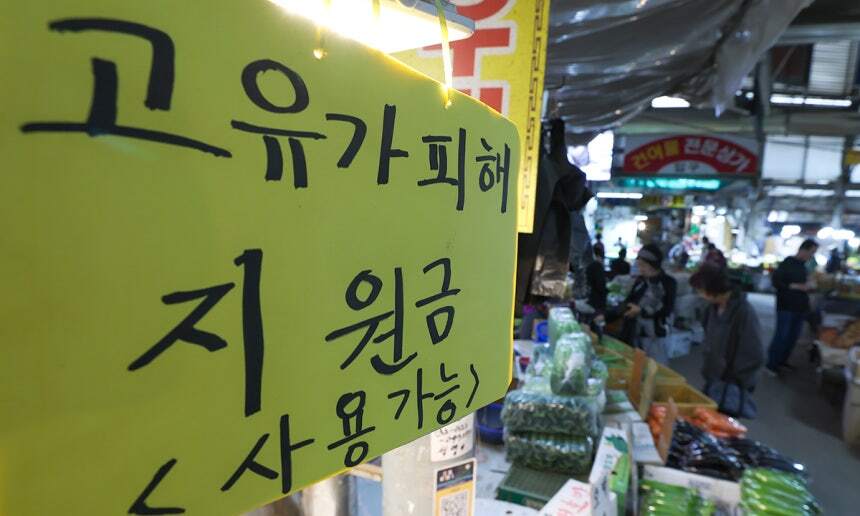
Selecting the bottom 70% of income earners using health insurance premiums
Excluding high-net-worth individuals and applying separate standards to single-person households
The government will disclose the criteria for selecting recipients of the second round of high oil price damage subsidies on the 11th. The plan is to use health insurance premiums to identify the bottom 70% of income earners, but separately exclude those with high net worth.
According to the Ministry of the Interior and Safety on the 10th, the government announced the criteria for selecting recipients of the second round of high oil price damage support payments and application methods on the 11th, and will then accept applications for the second round from the 18th to July 3.
The payment amount is 100,000 won per person for residents of the metropolitan area and 150,000 won for non-metropolitan areas. Among areas with population decline, residents in preferential support areas will receive 200,000 won, and those in special support areas will receive 250,000 won.
This second payment will be made to the bottom 70% of the population by income.
Health insurance premiums are used as selection criteria. However, it will go beyond simple income standards and include measures to exclude households with financial assets or real estate above a certain level.
It is reported that the government will also apply the selection method based on health insurance premiums that was used last year when disbursing the second round of consumption coupons for people’s livelihood recovery.
At that time, households were eligible for payment if the combined amount of out-of-pocket health insurance premiums was below a certain standard.
However, unlike at the time where the support target was the bottom 90% of income earners, this time the scope is narrowed to 70%. In addition, we plan to establish standards to separately filter out households with large financial assets and real estate.
Supplementary standards for each type of household are also established. Separate standards are expected to be applied to single-person households, reflecting the fact that the proportion of young people and the elderly is high. Special provisions also apply to dual-income households.
Previously, at the time of issuing consumption coupons, considering the relatively large burden of health insurance premiums for dual-income households, one additional household member was recognized. Accordingly, a two-person dual-income household was judged on the basis of a three-person household.
Meanwhile, the first round of subsidy applications for vulnerable groups closed at 6 p.m. on the 8th. The payment rate was calculated to be 91.2%.
The first payment amount was 550,000 won per person receiving basic livelihood security and 450,000 won per person from the next lower class and single-parent families. An additional 50,000 won per person was paid to residents of non-metropolitan areas or areas with declining populations.
Vulnerable groups who were unable to apply in the first period can also apply additionally in the second period.
In the first week of the second application, the day system based on the last digit of the year of birth is applied. Payment methods can be selected among credit/check cards, local love gift certificates, and prepaid cards.
The expiration date is August 31st, and any balance not used within the deadline will automatically be forfeited. If you apply for notifications through the National Secretary, which is available in 20 apps including KakaoTalk, Naver, and Toss, you can receive preemptive information on eligibility and application methods.
Copyright ⓒ Segye Ilbo. Unauthorized reproduction and redistribution prohibited.
Leave a Reply