


Swiss has become a Zurich branch of Lufthansa: This is good news for passengers
There is fear in Switzerland that the country will lose its national airline for the second time. But the nostalgics romanticize the past.
Swiss people still like to be transported by their “own” airline, even if other providers are cheaper or offer more comfort.
Goran Basic / NZZ
Lufthansa calls it an umbrella brand strategy. For sensitive Swiss minds, however, it is typically German intrusiveness.
Optimize your browser settings
NZZ.ch requires JavaScript for important functions. Your browser or ad blocker is currently preventing this.
Please adjust the settings.
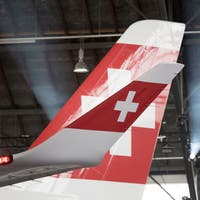
A year ago, Swiss started painting the words “Member of Lufthansa Group” on the aircraft – clearly visible next to the Swiss cross on the tail. Your lounges will also be addressed accordingly. And recently, passengers have even been informed of this in the on-board announcement by the Maîtres de Cabine: Swiss is a member of the Lufthansa Group.
You can twist and turn it however you want: Swiss has become a Zurich Lufthansa branch. It has an international structure with a Swiss touch. Frankfurt supplies the hardware, Kloten is responsible for the soft factors such as cabin scents, menus on board and color tones. If Lufthansa cancels free hand luggage, Swiss will follow suit. The numerous on-board tariffs have long since been standardized. But what is often complained about in Switzerland actually benefits passengers.
20 years ago it was said: “Swiss remains Swiss”
On July 1, 2007, Lufthansa took over 100 percent of Swiss. The successor airline to the legendary Swissair had previously made losses year after year. The new owners not only promised the survival of the then young company. But above all: “Swiss remains Swiss – even with Lufthansa.” That’s what the then Lufthansa CEO Wolfgang Mayrhuber said.
For a long time you could live well with this solution in Switzerland. Because Lufthansa seemed to keep its promise. She gave Swiss a lot of freedom. With the exception of the “Miles & More” loyalty program and the joint purchase of aircraft, the companies initially operated largely separately.
In return, Swiss became the jewel of the group. Thanks to a home market that was enthusiastic about travel and had purchasing power, it soon made nice profits. The Swiss cross still makes a significant contribution to this today. Whether in Tokyo, Cape Town or Los Angeles – Swiss takes Switzerland out into the world.
Swiss people can be found in the furthest corners of this planet. However, they still prefer to be transported there by their own airline – even if others are cheaper or offer more comfort.
Other countries have long since lost this type of connection with a transport company. Especially at the Lufthansa headquarters in Frankfurt, people are sometimes amused by the obsessive Swiss fixation in Switzerland, where even a change of manufacturer at the famous Schöggeli makes it into the national headlines.
The relationship between the Germans and Lufthansa is completely different: it is extremely sober. You’ll look in vain for references to home on the planes. The rear is not painted in the national colors, but with an abstract bird. By the way, this has nothing to do with the historically charged relationship that Germans have with patriotic feelings. The Lufthansa crane was designed in 1918 for the then Deutsche Luft-Reederei.
In recent years, however, an estrangement between passengers and their airline has also been observed in Switzerland. A key reason is that the performance was no longer up to par. Swiss’s punctuality, a core criterion for measuring quality in the watchmaking country of Switzerland, was at times alarmingly low. In the summer of 2024 it fell to below 50 percent. At the same time, an above-average number of pieces of luggage were lost at Zurich Airport.
Swiss also fell behind in terms of fleet, especially on long-haul routes. While the competition was upgrading, Swiss flew around the world with old, four-engine jets. The Internet is expensive and yet not reliable.
It was also noticeable that Swiss made incredibly high profits at a time when service was declining. In 2023 it reported an operating profit of 718 million francs. This was a phenomenal result in the notoriously tight airline industry, which operates with mini-margins.
It is true that Lufthansa has been tying its subsidiary airlines such as Swiss more and more closely to its Frankfurt headquarters for a long time. The integration has picked up speed recently – even insiders are amazed at the speed. When it comes to pricing, IT solutions, fuel procurement – Swiss is at the table, but Frankfurt has the final say.
In aviation, size is everything
So you shouldn’t be surprised that the impression arose that Lufthansa was only interested in first-class Swiss purchasing power and not in Swiss passengers. The sometimes strong public criticism also has to do with the fact that the Swiss are no longer so sure whether Swiss is still their airline.
But despite all the justified criticism, you shouldn’t mix things that have nothing to do with each other. There is little to suggest that Swiss would have delivered better quality if it had been able to act independently.
To be successful in aviation, size is crucial. The fact that Swiss is part of the Lufthansa construct is ultimately positive for Swiss customers. It benefits massively from the fact that Swiss, as part of the network, hedges kerosene prices, develops IT solutions that really work, and purchases aircraft. The order books at the manufacturers Airbus and Boeing will be full for years to come. As part of Lufthansa, Swiss is now getting a brand new A350. As a small Swiss airline, it would have to be at the back of the queue.
And Swiss would actually be small if it didn’t belong to Lufthansa. Today, thanks to the collaboration, the airline transports passengers from all over Europe to the world via its hub in Zurich – or vice versa. She wouldn’t have the strength to reach this customer base alone. But this helps significantly in filling the large long-haul jets. At the Swiss hub Zurich Airport, 29 percent are transfer passengers.
This is the only reason why it is worthwhile for Swiss to offer so many direct flights to the most important cities. The Swiss market alone would be far too small for the route network that the airline operates today. It is estimated that Swiss could only operate a third of today’s destinations profitably.
Not only tourism benefits from the many comfortable direct connections, but also the economy as a whole. Would Google have set up such a large office in Zurich if there were no daily flights to the other large locations in San Francisco or Boston? Barely.
The nostalgic people who mourn the golden days of Swissair should be reminded of what happened when Swissair itself wanted to play Lufthansa. With the aggressive Hunter strategy, it haphazardly bought up struggling European airlines in the 1990s. Their heavy losses led to their grounding in 2001.
Swiss is in a better position as a premium airline within a larger structure. But the advantages can only be fully exploited if the processes in the background are harmonized. That’s what’s happening right now. The current integration program is due to be completed this year: Swiss can control what the passenger experiences on board – the service, the staff, the marketing – itself. Everything else will be decided within the Lufthansa Group.
Those responsible have also recognized that they have to act. Swiss launched a new service concept for long-haul flights, is getting brand-new Airbus jets and will soon offer stable Starlink internet from Elon Musk.
Despite all the size advantages, you can’t overdo it with standard concepts. Lufthansa should not go further than now. She must allow that the experience on board a Swiss aircraft is different than sitting in a Lufthansa or Austrian Airlines plane. The Swiss Cross is considered one of the strongest brands worldwide. Anyone who claims to fly under this flag must differentiate themselves from the others with quality.
If Swiss can no longer provide this, passengers will automatically turn away from them. For European flights they will switch to a low-cost airline. And intercontinental to one of the numerous competitors who are contesting the landlady’s wealthy customers. In this country people react very sensitively to false Swissness. Anyone who promises this but does not keep it will be seen through.
Then Swiss can save the “Member of Lufthansa Group” on the aircraft in the future and paint over the cross with the crane. But everyone will lose as a result. Above all, Lufthansa. Because at the moment only one passenger airline within the group is making a profit – and that is Swiss.
Roland Lörtscher
The thing should fly from A to B without any accidents and fairly punctually, that’s it. If you think you have to work on a plane, you should rethink your replacement policy. And anyone who expects a 5-star menu and variable inflatable pillows has probably lost touch with sensible reality. Anyone who thinks about the loving care provided by the on-board staff of any airline and sees it as a sign of quality should know why it is done that way. Because this is how these people earn their money and not because they really like you as a person.
Annemarie Kisseleff
Hopefully the last advantage won’t be lost: at least there won’t be any strikes so far.
Leave a Reply