


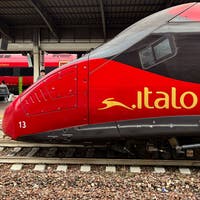
The rail operator Italo wants to compete with Deutsche Bahn and invest billions in the German location. However, the announced market entry could not happen – the Italians need support from politics.
A subsidiary of Italo wants to put trains on German rails from 2028.
Michael Nguyen / Imago
Luca Cordero di Montezemolo has achieved some things that others thought were impossible. In the 1970s, he took over the then notoriously unsuccessful Scuderia Ferrari racing team in Formula 1 – and transformed it into a global brand within just a few years. As a reward, he was later allowed to manage the entire Ferrari group for 23 years.
Optimize your browser settings
NZZ.ch requires JavaScript for important functions. Your browser or ad blocker is currently preventing this.
Please adjust the settings.
Now the now 78-year-old Montezemolo is facing his next daring mission. As CEO of the Italian railway company Italo, he wants to improve train traffic in Germany.
Montezemolo’s billion-dollar plans in Germany
If Montezemolo goes, it should work like this: From April 2028, thirty high-speed trains from Italo will run through Germany. Connections are planned every hour from Munich via Cologne to Dortmund and every two hours from Munich via Berlin to Hamburg.
The operation and production of the trains should take place entirely in Germany. Italo has already founded a subsidiary here, which will one day be run by German managers. Italo has already negotiated a contract with Siemens for the purchase of a first fleet worth 3.6 billion euros, Montezemolo recently told the “Frankfurter Allgemeine Zeitung”. The Siemens factory in Krefeld would particularly benefit from the order.
But Montezemolo still lacks certainty as to whether his trains will even be allowed to run on German rails. For this they would have to get a route. This is awarded by DB Infrago, a subsidiary of Deutsche Bahn. In fact, this is independent of the company DB Fernverkehr, Italo’s competitor. Discrimination against new applicants is not permitted under EU law.
Montezemolo insists on quick clarity: “We need certainty about the long-term allocation of network capacity by the end of May.” A billion-dollar investment requires preparation.
Italo raves about the competition
The Italians would not be the first private providers to shake up the German rail market. In many regions, private train operators dominate local transport. Since 2018, Flixtrain has been offering long-distance travelers an alternative to Deutsche Bahn. The green trains are cheaper – but also more uncomfortable and often slower.
Italo’s market entry would have a different quality. The Italians want to attack Deutsche Bahn in its most profitable segment: long-distance transport with high-speed trains. Deutsche Bahn has enjoyed a de facto monopoly here, controlling around 95 percent of all long-distance trains in the country. At the same time, many travelers complain about poor quality. Nowhere are trains more often unpunctual than in Germany – a problem that German railway boss Evelyn Palla wants to remedy by restructuring her company.
Montezemolo’s story goes differently. He believes that rail transport in Germany will only improve with more competition. The entry of a competitor into the market increases the pressure on the established provider – and makes the railway better and cheaper for everyone.
Luca Cordero di Montezemolo, here at an event in 2024, wants to shake up German rail traffic with Italo.
Imago
This was proven when Italo was founded, argues Montezemolo. The private company’s market entry in 2012 spurred state-owned Trenitalia, previously the only provider of important long-distance routes such as that from Milan to Rome, to provide better services. Fares have fallen by 40 percent, the frequency on the main routes has tripled and the number of passengers has doubled. “We believe that German high-speed rail traffic can grow by up to 40 percent – in line with what competition has achieved in Italy,” says Montezemolo.
The success of the Italian railway operations in the home country also attracted new investors. The Geneva shipping company MSC has held almost half of the shares in Italo since 2023. On the Italian main routes, the private provider’s market share amounts to a third.
Delicate time to enter the market
Christian Böttger is a professor at the Berlin University of Technology and Economics and a railway expert. He says of Italo’s announced market entry: “More competition would be good for the German railway market; the investments would be an important signal for the industrial location. “But I think it’s unlikely that approval will work in the time frame we hope for.”
DB Infrago is currently hardly issuing any new licenses, says Böttger. This is due, among other things, to the fact that the rules of the game when allocating routes could soon change: The EU is due to present a new directive soon, which is why the Ministry of Transport has little interest in a fundamental debate. In addition, the scope for new trains is limited, says Böttger: “The German rail network is already overloaded at important junctions.” In cities in particular, what is currently needed is not more connections, but fewer connections. Approvals for Italo trains would therefore only be possible with restrictions for regional traffic, says the rail expert. That in turn would be unpopular in the federal states: “I doubt that Italo will get the necessary political support.”
Italo writes when asked: “If you invest billions in Germany, you need a long-term perspective. To do this, we need above all clear rules for allocating routes to new competitors as well as reliability when awarding framework contracts, because in the end they reduce complexity and create planning security for new competition. Italo will create capacities where they are needed. The company wants to coordinate with the existing regional operators.
Montezemolo will need help so that one day he can travel through Germany on one of his trains. Otherwise he only has the Ferrari as his means of transport.
Leave a Reply