


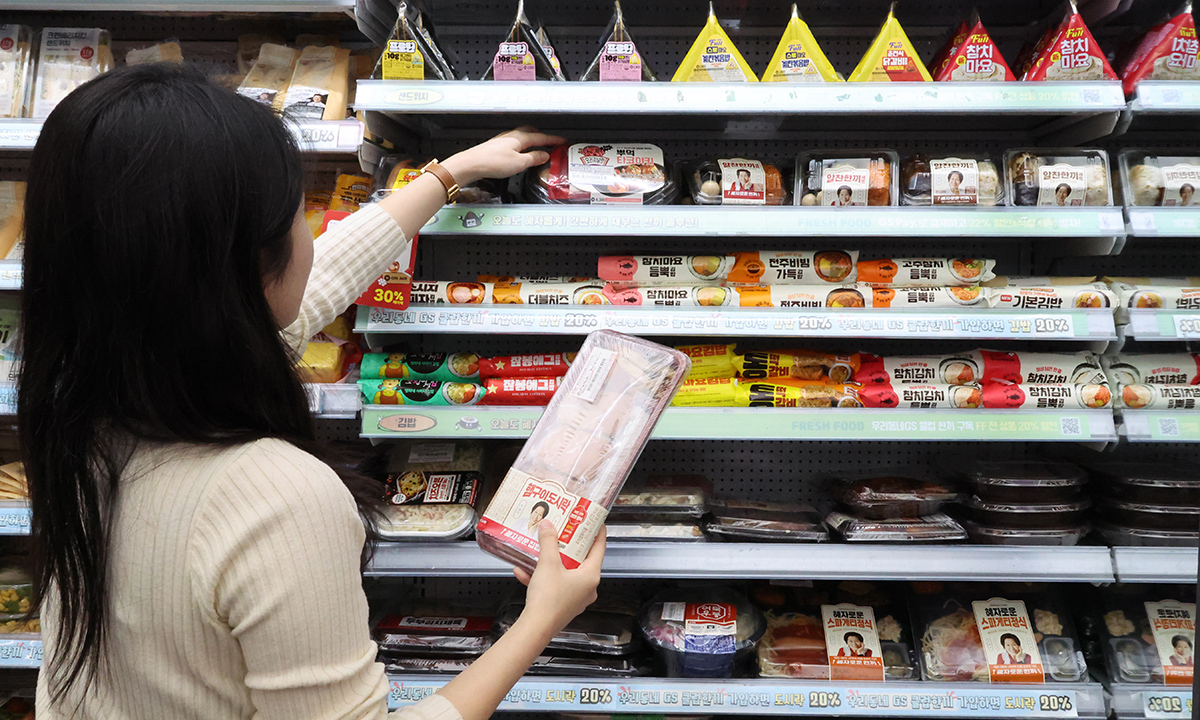
“For breakfast, I eat a meal that costs 1,000 won, and for lunch and dinner, I go through the convenience store app and look for convenience food that is on a last-minute discount. This way, I can get all three meals for less than 10,000 won.”
On the 24th, Mr. Lee (24), a student at a university in Seoul, showed off his smartphone, saying it was a way to save money on food. On the app’s ‘Final Discount’ page shown by Mr. Lee, a 4,800 won lunch box that was nearing its expiration date was listed at 3,840 won, a 20% discount. If you eat three meals a day like this, the total food cost is only 8,680 won. Mr. Lee sighed, saying, “Compared to my freshman year, nothing has gone up, from monthly rent to food expenses, but my pocket money is the same. There is no answer other than reducing food expenses.”
As ‘inflation’ (increasing prices) worsens due to the prolonged economic recession and the recent surge in oil prices from the Middle East, the number of people in their 20s and 30s who are tightening their belts is rapidly increasing. In particular, they seem to be focusing on reducing the cost of food, which is the most immediately controllable of the essential elements of life such as clothing, food, and shelter.
In fact, according to the convenience store industry, demand for products that are close to closing is steadily increasing. Last year’s sales of the last-minute discount service within GS25’s mobile app ‘Our Neighborhood GS’ soared 132.2% compared to the previous year. The strategy of selling meal replacement items such as lunch boxes, hamburgers, and sandwiches at up to 45% discount was successful. CU also saw an increase in closing discount sales through the ‘Pocket CU’ app by more than 20% last year, and 7-Eleven and E-Mart 24 are also recording related sales growth of around 10% every year.
Mr. Moon (62), who runs a convenience store in Gwanak-gu, Seoul, said, “In the past, there were quite a lot of lunch boxes and kimbap that were discarded, but these days, people look at the app and buy them like ghosts hours before the expiration date.” He added with a bitter smile, “It is fortunate that waste has decreased, but it means that young people are having a hard time with their pockets.”
Communities and services that share information about cheap restaurants are also popular. ‘Beggar Map’, which provides information on cost-effective restaurants under 8,000 won, is gaining explosive popularity, exceeding 1.46 million users in just 23 days of its launch. Mr. Kim (38), an office worker, said, “The food subsidy from the company is about 10,000 won, but these days, there are almost no restaurants in Seoul that cost 10,000 won.” He added, “It has become a daily routine to search for cost-effective restaurants through Beggar Map.”
Experts analyze that this phenomenon is going beyond simple saving and is becoming entrenched as a ‘survival strategy’ to survive the era of high prices. It is pointed out that if ‘Jantech’ was a choice for saving in the past, it has now become an essential requirement for maintaining a living in the 2030s.
Lee Eun-hee, a professor of consumer studies at Inha University, said, “Young people are facing difficult situations, such as high prices and high unemployment, but thanks to the activation of online communities, young people in the same situation are sharing information and solidarity with each other and wisely enduring this,” and predicted, “As long as political instability in the Middle East and economic recession continue, this kind of savings-oriented consumption is likely to continue for the time being.”
Copyright ⓒ Segye Ilbo. Unauthorized reproduction and redistribution prohibited.
Leave a Reply