


Possibility of realizing ‘reflective profits’ from competitors
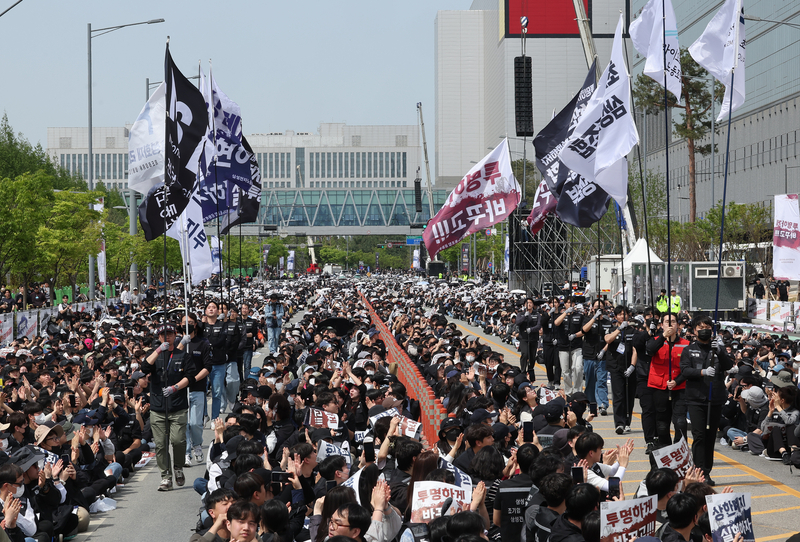
While the Samsung Electronics union has announced a strike, a warning has been issued that if the strike becomes a reality, economic losses worth tens of trillions of won and damage to trust in the global supply chain are inevitable.
◆ Samsung Electronics strike has bigger invisible costs
According to the industry on the 26th, Professor Song Heon-jae of the Department of Economics at the University of Seoul made this prediction on the topic of ‘the ripple effect of the Samsung Electronics union strike’ at the recently held Anmin Policy Forum seminar.
Professor Song predicted that if the Samsung Electronics union’s strike becomes a reality, the loss due to factory operation would be billions of won per minute, or 1 trillion won per day, and pointed out that if the strike is prolonged, up to 10 trillion won in operating profit could be lost in the semiconductor sector alone.
In particular, customer anxiety, customer withdrawal, and pressure to reorganize the supply chain were pointed out as bigger risk factors than short-term sales decline. Professor Song pointed out, “Global big tech customers may begin reviewing alternative supply lines, such as TSMC, to diversify risk,” and added, “Due to the nature of the semiconductor industry, which requires enormous costs and time for process verification, it is difficult for customers who leave once to return.”
In fact, major customer companies consider supply stability as a key evaluation criterion. AMD is reportedly reflecting supply chain resilience in its ESG evaluation, and Nvidia is known to directly reflect supplier evaluation results in volume allocation. For this reason, there are concerns that production disruptions due to strikes could directly lead to a weakening of global competitiveness.
Professor Song divided the cost of a strike into ‘visible costs’ such as production interruption and decreased sales, and ‘invisible costs’ such as weakened trust, delayed investment, and shock to the industrial ecosystem. In particular, key risks were identified as △destruction of trust assets △market loss due to transition costs △opportunity cost in artificial intelligence (AI) semiconductor competition △exodus of key talent △intensification of Korea discount.
Professor Song said, “Semiconductor technology loses its competitiveness even if it is just one to two years behind,” and pointed out, “While NVIDIA, TSMC, and Intel are engaged in a life-or-death competition for AI semiconductor hegemony, wasting their capabilities on resolving internal conflicts is itself a huge opportunity cost.”
Recently, Taiwanese media reported that if Samsung Electronics’ production disruption becomes a reality, it will be an opportunity for Taiwanese semiconductor companies to benefit and increase their price negotiating power.
The Samsung Electronics strike may have a negative impact on the overall industrial ecosystem comprised of 1,764 subcontractors (materials, parts, equipment) partners. In the case of the Pyeongtaek campus, each production line is known to create employment for approximately 30,000 people, including partners, so there are concerns that a direct hit to the large-scale employment base and local commercial districts will occur if operations are halted.
The possibility of counter-profits is already being discussed overseas. Taiwanese media reported that if Samsung Electronics’ production disruptions become a reality, Taiwanese semiconductor companies such as TSMC may have an opportunity to increase their price negotiating power.
Meanwhile, Professor Song pointed to the opacity of performance bonus calculation standards and information asymmetry as the cause of this conflict, and mentioned the ‘Hicks Paradox’, which explains the inefficient balance between labor and management. As solutions, they suggested △disclosure of performance compensation standards △establishment of a compensation system based on ROIC, TSR, and EVA △differential distribution by profit section △introduction of upper/lower limit/clawback devices △external verification and arbitration system △institutionalization of pre-strike mediation procedures.
◆ Samsung Electronics strike is not a simple suspension… ‘Hard times’ until restart
Meanwhile, the Samsung Electronics Union Joint Struggle Headquarters announced that it will begin a general strike for 18 days from the 21st of next month to June 7th. According to the union, if the strike becomes a reality, it is predicted that losses will amount to about 1 trillion won per day, or at least 20 to 30 trillion won over 18 days.
The industry expects that the scale of this strike will also be different from the past. It is estimated that the number of participants at the time of the strike in July 2024 was 5,000, which was only 15% of all union members at the time. Since there were not many strikers, production disruptions were prevented by utilizing alternative work arrangements.
However, it is estimated that the number of people participating in the general strike in May will range from 30,000 to 40,000. This amounts to 30-40% of all union members. If they actually go on strike, it will be difficult to protect against production disruptions with replacement workers.
A semiconductor fab requires an ultra-high purity, defect-free environment. It takes time to restore the clean room condition and chemical piping that collapsed due to the shutdown. In addition, each of the hundreds of pieces of precision equipment that performs nanoscale processes must be manually reset to zero and precisely verified for normal operation using test wafers.
In addition, a stabilization period is needed to empty the line by disposing of existing, neglected and contaminated wafers, and to raise the yield again until the target good product ratio is reached.
Copyright ⓒ Segye Ilbo. Unauthorized reproduction and redistribution prohibited.
Leave a Reply