


It’s worth missing the tram – caffeine brings Zurich’s oldest kiosks back to life
Flat white and matcha are replacing magazines: commuters are now buying freshly roasted “specialty coffee” at transport hubs.
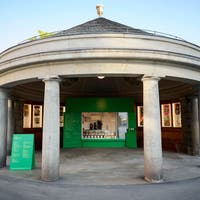
A temple on Kreuzplatz for the “best possible coffee experience”: Mirò opens a café in one of Zurich’s oldest kiosks.
PD
They are defiant palaces, temples or streamlined concrete sculptures. What they all have in common is that they reflect and celebrate the development of public transport: the Zurich tram waiting halls.
Optimize your browser settings
NZZ.ch requires JavaScript for important functions. Your browser or ad blocker is currently preventing this.
Please adjust the settings.
Until now, commuters and passengers were blind to these small buildings devised by earlier city architects. No wonder, after all, smartphone users hardly bought newspapers and magazines at the kiosks there anymore, perhaps chewing gum or cigarettes.
But now even the hip matcha fans, the filter coffee drinkers and the flat white sippers are likely to take notice. For example, the chapel-like house on Kreuzplatz from 1918.
On Friday, the trendy coffee manufacturer Mirò opened a frog-green coffee window in the little temple. There are a dozen seats on the wooden benches, and a permit for three tables has also been applied for from the city. The small business with its own specialty coffee roastery has made a name for itself with coffee windows at the main train station and a spacious restaurant in District 4.
The dome reflects the past of Kreuzplatz
With this and thanks to the new lighting by architect Florian Ringli, the building, which is over a hundred years old, is once again brought into its own: If you sit under the dome of the small building, which has been deemed worthy of protection, your eyes wander over oval paintings. One of these plaster paintings is reminiscent of the Plague Church of the Cross. This was built in the 17th century on Kreuzplatz for the three former communities of Hirslanden, Hottingen and Riesbach, whose coats of arms are also present. Another picture shows the village fountain, which was later built in place of the church. In 1918, Friedrich Fissler created the tram waiting hall, which is reminiscent of the former sacred building – now with a shrine for the “best possible coffee experience”.
Considered a sign of progress: the tram waiting hall at Kreuzplatz, taken in 1938 by Michael Wolgensinger.
Zurich architectural history archive
Architectural history archive
Architectural history archive
The plaster paintings by Wilhelm Hartung show the former Plague Church of the Cross and the coat of arms of the former village of Hottingen.
Daniel Sanchez is the operator of Mirò. He dealt with the construction. He says the square has been reinvented again and again over the centuries. The dome connects the urban, political and religious history of the districts. It documents how the place developed from a sacred center to an urban transport hub.
Friedrich Fissler not only created the little temple, but in 1911, seven years earlier, the oldest surviving kiosk at the Pfauen. This spring it became a café. The operator Fabian vonrechnerberg says that the interest from customers exceeds all expectations. The historic tram waiting halls are being revived thanks to caffeine. In addition to a smartphone, commuters’ standard equipment includes a coffee mug.
Young roasters initiated this development years ago and opened seemingly improvised coffee windows. Just think of the “Schmück To Go” on Badenerstrasse, the “Anny-K” in the up-and-coming area around Sihlfeldstrasse or the popular “Hegifret” on Hegibachplatz.
The numbers prove them right. According to the Cafetier Association, the Swiss are among the world’s top coffee consumers. And the population is drinking more and more, despite rising prices every year. They are highest in Zurich, the most expensive coffee city in the country. According to the 2025 survey, a café crème here costs an average of 4 francs 91, which is 5 centimes more than in the previous year.
The Zurich Transport Authority (VBZ) has jumped on this bandwagon. In 2024 they re-advertised the locations of the four tram waiting halls: Kunsthaus, Paradeplatz, Triemli and Kreuzplatz. It was no longer the Valora kiosk chain that won the contract – although it still serves 13 city public transport stops – but rather young catering companies from the coffee scene.
Once Mirò Coffee achieved the highest score, three times it was the companies with Fabian vonrechnerberg’s participation that emerged from the aforementioned “Hegifret”: twice Juni Kaffeefenster AG, once Murphys Coffee GmbH.
The oval concrete roof of the Triemli tram station from 1969 allows rainwater to flow into the fountain.
Zurich architectural history archive
High-quality coffee is also in demand on the outskirts of the city: the “Murphys” at the Triemli terminus.
Dennis Cobarrubias / PD
The backdrop of the “Murphys” is spectacular: an oval concrete roof by Erwin Müller, one of the Triemli Hospital architects, has stretched over the terminus since 1969. In the glass cube below, Dennis Cobarrubias is the managing director. He previously worked in the “Kaffeewerkstadt” at the Wiedikon blacksmith shop and taught barista courses. Now he is ensuring a peaceful coexistence of the hot drinks trend and the K-Kiosk at “Murphys”; He brews coffee for his colleagues at the Valora kiosk and chats with them through the window. He talks to marginalized people and talks shop with coffee aficionados about the fruity taste of a Colombian filter coffee.
Here, on the outskirts of the city, you have time to read newspapers, some copies are available on a vintage table. The demand for good coffee is noticeable at the final stop, says Cobarrubias as he prepares a matcha latte for 7 francs 50. He was able to win employees of the city hospital as regular customers and they receive a 10 percent discount. But he also says he’s happy to see even more coffee drinkers.
Meanwhile, things are getting more hectic at the new coffee window on Paradeplatz, the bankers are getting loyalty cards. The tram waiting hall, built in 1928 according to plans by Hermann Herter, imitates rush hour with its streamlined shape. The elegant small building still houses a kiosk on one side and the new “Juni” coffee window on the other. Sheila Lopardo, who also runs the Tanzhaus’s “Nude Bar”, is involved here and at the Pfauen coffee window. She is currently busy training a new employee to use the coffee machine. The customers are more impatient than at Triemli – and more solvent. According to the cafeteria association, a cappuccino costs an average of 5 francs 37. In “June”, commuters pay 5 francs 80. For the flat white with oat milk even 6 francs 70.
The area of the house on Paradeplatz was deliberately divided. This is what Judith Setz, media spokeswoman for the VBZ, says. The demand for classic kiosk products such as newspapers and magazines has decreased in recent years. Meanwhile, interest in high-quality coffee and snacks has increased, especially during the morning and midday rush hour.
Setz emphasizes that the new coffee windows offer fits better into the everyday lives of commuters and neighborhood residents. The concepts strengthen the attractiveness of public transport and contribute to the positive perception of the stops.
The old aunt as the namesake
And they make you smile. Last October, Fabian vonrechnerberg told the NZZ that the plan was to use the name te Minicafé at Pfauen undecided. The subsequent NZZ report mentioned that the round kiosk was once insulted as a “pug” because of its oversized roof and pompous pillars.
Such four-legged friends like to be taken for walks on the Zürichberg. rechnerberg and his team turned the “insult” into a virtue. They quickly named the café “Mops”. And they added vegan treats to their range – for pugs and all other dogs.
The classic kiosk on Kreuzplatz around 1990. It has had its day. Commuters would rather buy coffee.
Architectural history archive
Leave a Reply