


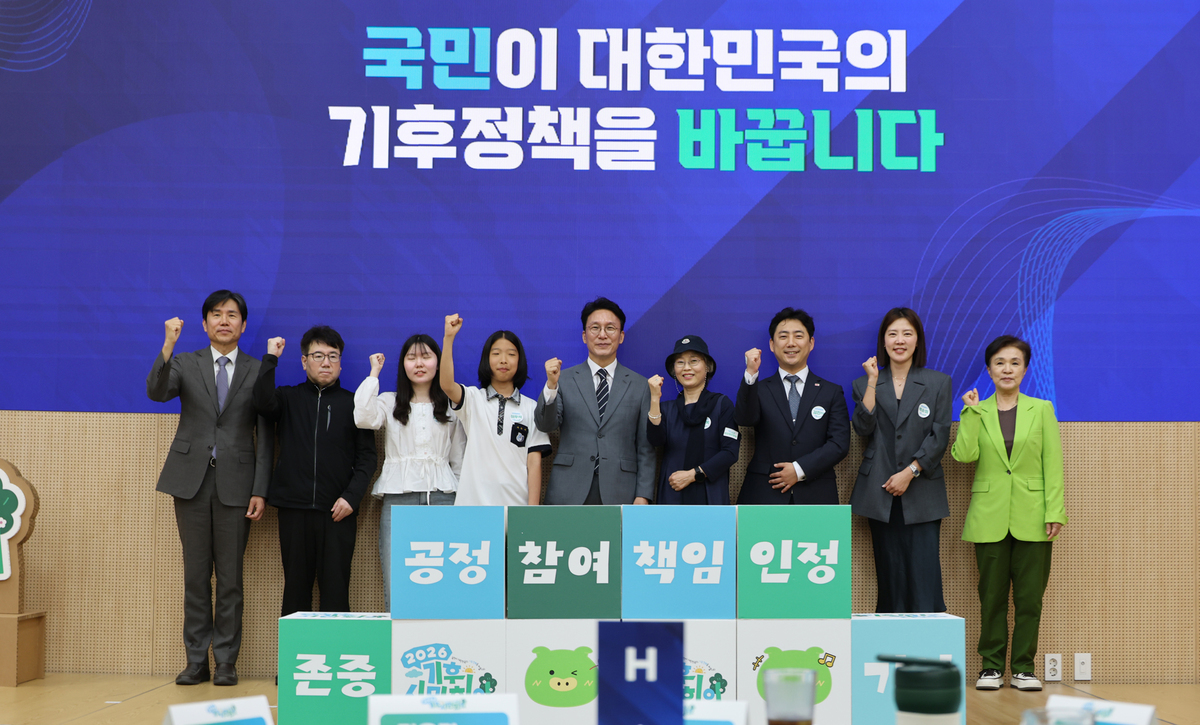
The ‘Climate Citizens’ Conference’, a Korean-style climate public forum presented by the Lee Jae-myung administration as a national task to realize carbon neutrality, has been launched in earnest. When 200 citizen participants discover policies and make recommendations in the areas of greenhouse gas reduction and climate adaptation, the government will reflect them in actual policies.
On the 16th, the President’s National Climate Crisis Response Committee held an inauguration ceremony for the Climate Citizens’ Assembly, a permanent organization for climate public debate, at the Korea Science and Technology Center in Gangnam-gu, Seoul.
The Climate Citizens’ Meeting is a deliberative participatory organization where citizens study and discuss climate policies and propose opinions to the government. It has been promoted as a national task by the Lee Jae-myung administration, and the legal foundation was laid with the passage of the amendment to the ‘Framework Act on Carbon Neutrality and Green Growth in Response to the Climate Crisis (Framework Act on Carbon Neutrality)’ on March 12 at the National Assembly, which contains the basis for the establishment of the Climate Citizens’ Council.
The Climate Citizens’ Conference consists of a planning and deliberation group of 200 people. The government randomly secured a pool of 2,000 candidates and then selected the final participants by reflecting demographic characteristics such as region, gender, and age.
The 20 members of the planning participation group will set the agenda to be discussed at future climate citizens’ meetings and prepare operating regulations. The 10-member external advisory group advises and supports the activities of the planning participation group.
After setting the agenda, 180 deliberation members (120 from the reduction division and 60 from the adaptation division) each identify policy tasks in the areas of greenhouse gas reduction and climate change adaptation. The government is also considering establishing a delivery system using educational experts such as environmental teachers so that the general public can easily understand climate and environment-related policies and science and technology information.
The deliberation group will discuss 6 to 8 times over a period of about 3 months starting from the end of June and prepare a final recommendation in September. The recommendations are scheduled to be reflected in actual policies for final deliberation and resolution at a plenary meeting of the Climate Response Committee in November.
The government has established a policy to operate the Climate Citizens’ Conference as a permanent organization rather than a one-time public forum.
It is expected to be the first time in the world that a national climate citizen conference is established and held annually. The government plans to use this year as the first year of permanent establishment and establish a best example of citizen participation in carbon neutrality policies at home and abroad.
To this end, the National Climate Crisis Response Committee also ordered policy research services to establish a permanent Climate Citizens’ Conference on the 21st of last month. The plan is to evaluate and analyze the entire operation process this year, the first year, and prepare a roadmap for permanent establishment.
Lee Chang-hoon, Chairman of the National Climate Crisis Response Committee, explained, “The planning team that sets the agenda is comprised entirely of citizens, so the structure gives citizens more authority,” adding, “Agenda setting is open without a set topic.”
Chairman Lee said, “The results of the Climate Citizens’ Meeting will be reported to the Climate Crisis Response Committee, and the committee will listen to the opinions of related ministries based on this,” and added, “We will strive to ensure that the content proposed at the Climate Citizens’ Meeting is reflected in policy.”
Copyright ⓒ Segye Ilbo. Unauthorized reproduction and redistribution prohibited.
Leave a Reply