


‘El Nino warning’ issued amidst unusual events such as floods in the Middle East and drought in Africa
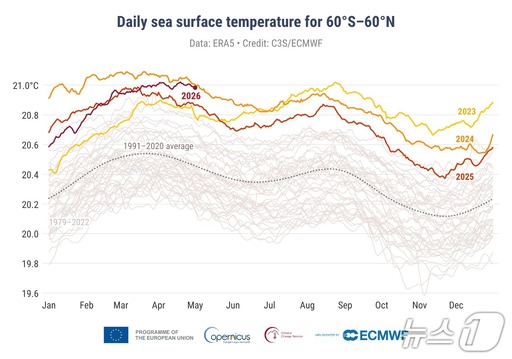
Last April, global sea surface temperatures reached the second highest level on record. As the marine heat wave continued centered in the tropical Pacific Ocean, the Arctic sea ice area was also the second smallest since observations were made.
The Copernicus Climate Change Service (C3S), operated by the European Center for Medium-Range Weather Forecasts (ECMWF), released a monthly climate report containing this content on the 8th (local time).
The global average temperature last April was 14.89 degrees, 0.52 degrees higher than the average from 1991 to 2020. Compared to the pre-industrial average (1850-1900), it was 1.43 degrees higher, making it jointly the third hottest April on record.
The average sea surface temperature in April in the oceans (60 degrees north latitude to 60 degrees south latitude) excluding Antarctica and the North Pole was 21.00 degrees, the second highest in observed history. In particular, a strong marine heat wave occurred from the central equatorial Pacific Ocean to the western coasts of the United States and Mexico.
C3S analyzed that El Niño conditions are likely to form in the coming months. El Niño is a phenomenon in which the sea surface temperature in the equatorial Pacific becomes higher than normal, and is considered a factor in increasing global temperatures and intensifying abnormal climates.
In Europe, there was a large regional temperature difference. Spain recorded its hottest April on record, but Eastern Europe had colder-than-normal temperatures. Overall, April in Europe was the 10th warmest since observations were made.
Arctic sea ice extent is about 5% less than normal, falling to the second-lowest level on record. The explanation is that the low sea ice extent that has continued since early this year has continued.
The Antarctic sea ice area was also about 10% less than normal. It was the 11th lowest level since observation.
Extreme weather events continued throughout the world in April. A tropical cyclone occurred in the Pacific Ocean, and large-scale flooding and landslide damage occurred in the Middle East and South Central Asia.
Flash floods occurred throughout the Arabian Peninsula, and casualties continued due to floods and landslides in parts of Iran, Afghanistan, Saudi Arabia, and Syria. Drought damage has been reported in South Africa.
News 1>
Copyright ⓒ Segye Ilbo. Unauthorized reproduction and redistribution prohibited.
Leave a Reply