
“The National Assembly should enact a proper basic life safety law!”
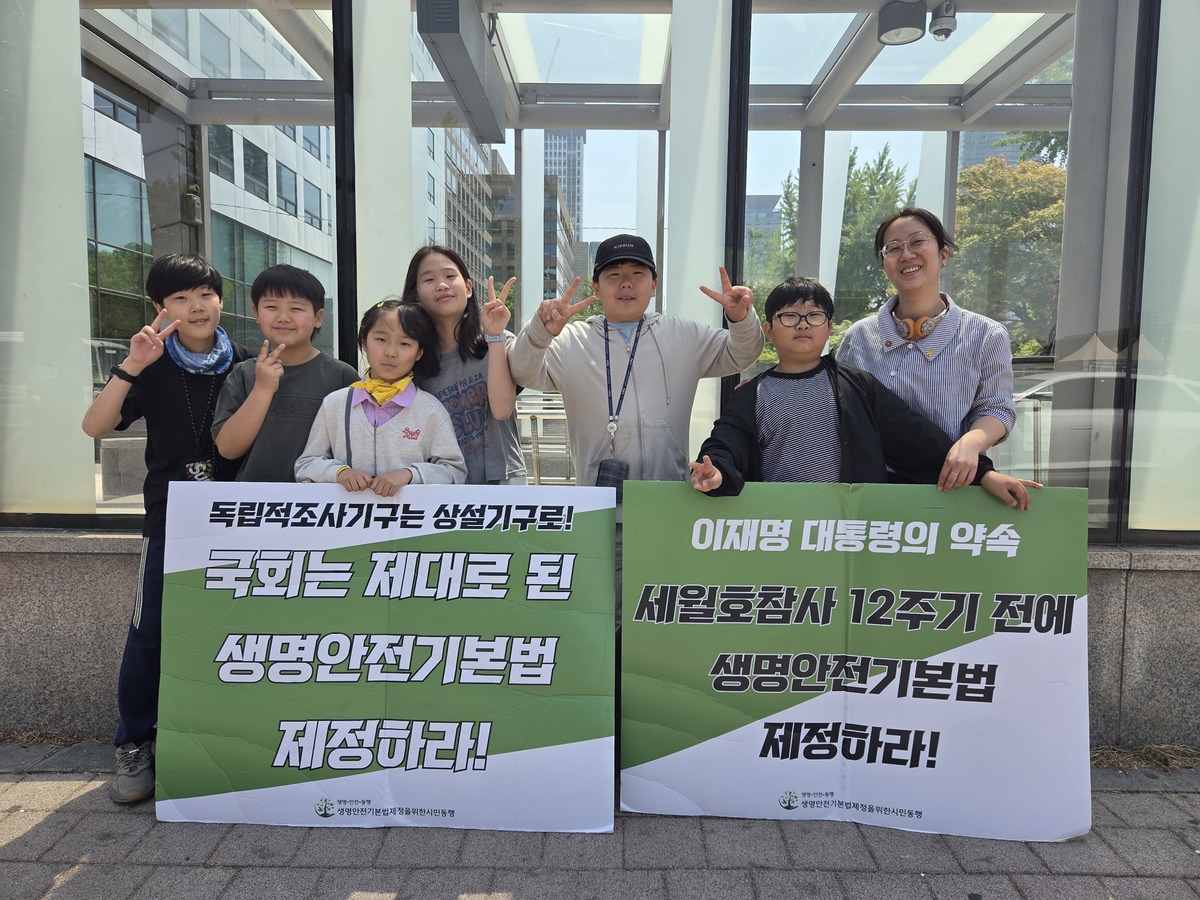
On the 6th, a day before the Basic Life Safety Act was to be submitted to the plenary session of the National Assembly, 12 elementary school students stood in front of the National Assembly. They held signs the size of their bodies and urged the passage of the bill. The sight of elementary school students standing side by side in front of the National Assembly, which was crowded with members of the National Assembly, National Assembly staff, and rally participants, attracted the attention of citizens.
These are 4th to 6th grade elementary school students attending ‘Byopssi School’, an alternative school in Gwangmyeong-si, Gyeonggi-do. Lee Hee-yeon (39), a teacher who guided the children, explained in a phone call with Segye Ilbo on the 10th, “I went to the field at the suggestion of the children who said, ‘I want to go out at least once before the law is passed.’”
The Framework Act on Life Safety is a law that codifies the life and safety of citizens as a right that the state must guarantee. The ‘right to safety’, which is the right to live safely with life, body, and property protected from the risk of safety accidents, was specified, and the legal basis for guaranteeing the rights of not only the victims but also related parties such as family members and witnesses was included as ‘victims’.
Mr. Lee emphasized that this picketing was led by children, not teachers. He explained, “Three years ago, I went to a legislative debate on the Basic Life Safety Act held at the National Assembly with my students, and the younger siblings of the seniors who participated then are now in the same class.” He explained, “When I heard that the law was being passed this time, I talked about whether I should go out at least once before that and started preparing for picketing.”
Wouldn’t the topic of social disasters and disasters be too heavy and difficult for children? Mr. Lee said that such concerns were almost unfounded. He said, “The children knew everything, including the Sewol Ferry disaster and the Jeju Air disaster. We looked at past debate materials and thought and read together, ‘What is this about?’”
There were also people who gave warm cheers to the children standing at the entrance to the National Assembly. Mr. Lee said, “The person wearing the badge shouted, ‘I will make sure you pass,’ and left.” However, not all reactions were warm. Mr. Lee said, “When a citizen passing by said, ‘Are you still talking about the Sewol Ferry?’, the children were very confused,” and added, “We talked about why the Sewol Ferry was not over yet and whether the government would take responsibility and resolve the issue if another disaster occurred.”
Byopssi School students have also participated in the participatory budgeting system held in Gwangmyeong City and the ‘500 Gwangmyeong Citizens Round Table Discussion’. Mr. Lee said, “I believe democratic citizenship education cannot be separated from political education,” and added, “I hope that children learn how to use the rights guaranteed by the state and raise their voices, sometimes through the budget system and sometimes through protests.”
The Basic Life Safety Act, which is also the long-awaited wish of the Sewol ferry victims’ families, was passed in the plenary session of the National Assembly on May 7 this year, 12 years after the disaster. It is said that the children were very happy after news of the bill’s passage was announced. Mr. Lee said, “There was a school meeting that evening, and some children heard the news and screamed in the hallway. The children said, ‘I think we are happier because we raised our voices together and the law was passed the next day.’”
At the same time, the children’s questions soon moved to the next step. The questions were, “Then will it end?”, “When will it start?”, and “Do we need to make another enforcement ordinance?” Mr. Lee said with a smile, “The children know from experience that not everything will change right away just because a law is made, and that enforcement ordinances are needed to fill in the holes,” and added, “We decided to find out more together about what follow-up measures are needed. I also have to study.”
This year, Mr. Lee visited the Sewol Ferry remembrance ceremony with his children. Among the students, the 6th graders were born in 2014, when the Sewol Ferry disaster occurred. Although I have no memory of the day of the disaster, there were no obstacles blocking solidarity. Mr. Lee said, “I talked to the kids about things like, ‘This older sister had the same favorite character as me,’ and ‘This older brother dreamed of becoming a chef just like me.’” He added, “It was a time to think about how ordinary people the people who passed away were.”
12 years after the disaster, the Basic Life Safety Act has passed the National Assembly, but there is still a long way to go. The law takes effect six months after its promulgation following a resolution by the State Council. In the meantime, specific enforcement standards, enforcement ordinances, and budget security measures must be followed. Mr. Lee said, “I think it is the first step, not the end,” and “I hope that the law passed this time will be a law that guarantees the life and safety of the children I met and ordinary people.”
Copyright ⓒ Segye Ilbo. Unauthorized reproduction and redistribution prohibited.
Leave a Reply