


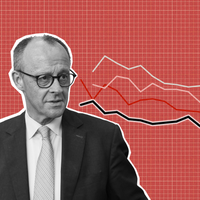
One year after taking office, Friedrich Merz is far behind his predecessors. The most important figures, updated regularly.
Updated
Merz already started office with poor poll numbers.
Illustration Cian Jochem / NZZ
No German chancellor since 1998 has had such weak approval ratings in his first year in office as Friedrich Merz. After twelve months, only 16 percent of those surveyed are satisfied or very satisfied with their work.
Optimize your browser settings
NZZ.ch requires JavaScript for important functions. Your browser or ad blocker is currently preventing this.
Please adjust the settings.
Angela Merkel, who like Merz belongs to the CDU, achieved 47 percent after one year in her first term as chancellor, while SPD chancellors Olaf Scholz and Gerhard Schröder each got 36 percent. Approval ratings were also higher in Merkel and Schröder’s later terms of office. This is shown by representative survey data from Infratest Dimap, which has been collected since 1997.
Merz started weakly and continued to lose support. Already at the beginning of his term in office, approval was lower than for Merkel, Scholz and Schröder. At no point did he reach the values of his three predecessors. Even after twelve months, Merz remains behind.
The finding corresponds to data from the elections research group. Since 2005, it has also been regularly surveying how citizens rate the Chancellor’s work. In this time series too, Merz is clearly behind Merkel and Scholz after one year.
The government is also generally unpopular
The poor poll numbers are not limited to the Chancellor, however. After one year, the black-red coalition of CDU/CSU and SPD is also more unpopular than any other federal government at the same time since the “Germany trend” began in 1997.
The dissatisfaction is also reflected in the Sunday question – i.e. the question of which party citizens would vote for if there were a federal election next Sunday. The NZZ combines surveys from several institutes every day. The result: the Union and the SPD have lost significantly since the government took office. Black and red would no longer have a majority at the moment. At the same time, the AfD is ahead of the CDU/CSU.
The coalition’s assessment of the latest “Germany trend” is accordingly sobering. A relative majority of eligible voters are now against the black-red coalition continuing to govern until the end of the legislative period: 49 percent want the coalition to end early, only 44 percent want it to continue. The next regular federal election is scheduled for 2029 – assuming the coalition holds until then.
Major issues remain unresolved
Many respondents doubt that the government can solve key problems. Trust in their economic and social policies is particularly low. Added to this is the dissatisfaction with the coalition’s performance: the ongoing public dispute between the CDU/CSU and the SPD has apparently reinforced the impression that the government is not acting as a united front.
Merz’s problem is therefore bigger than dissatisfaction with his personal work. He began his chancellorship with promises to strengthen the economy and place greater restrictions on migration. But after a year, many citizens have the impression that the entire government is neither producing convincing results nor convincingly explaining its policies.
Leave a Reply